
Most organisations do not lose money because they lack process documents. They lose money because work is inconsistent, knowledge sits with a few people, approvals stall, and nobody trusts which version is current, leaving teams without control over their processes.
That creates hidden costs every day.
Process management ROI is simply the return you get from improving the way work is done. This sits at the core of business process management.
You measure it by comparing the cost of poor processes today against the savings created by reducing delays, rework, audit effort, onboarding time, and operational risk.
A purchase request sits in someone’s inbox for a week. A team repeats work because they followed an old process. A new employee takes months to become productive because they rely on tribal knowledge. An audit takes weeks because evidence is scattered across Word files, PDFs, SharePoint folders, and spreadsheets.
ProcessPro fixes those problems at the source.
How Do You Measure Process Management ROI?
A simple way to calculate process management ROI is:
ROI = Annual Savings Created by Better Processes – Cost of the Software and Implementation
The savings usually come from:
Reduced rework
Faster onboarding
Shorter audits
Fewer operational failures
Less time spent chasing approvals
Less dependency on key staff
For example, if better process management saves 500 hours a year, and your average labour cost is $50 per hour, that is $25,000 in recovered productivity.
If you also save $15,000 in audit effort and reduce process failures worth another $10,000, the total annual return is $50,000.
What Are the Hidden Costs of Poor Process Management?
Most organisations do not realise how much poor process management costs until they start measuring it.
Delays, duplicated work, slow approvals, inconsistent service, and audit preparation all create hidden costs that build up over time.
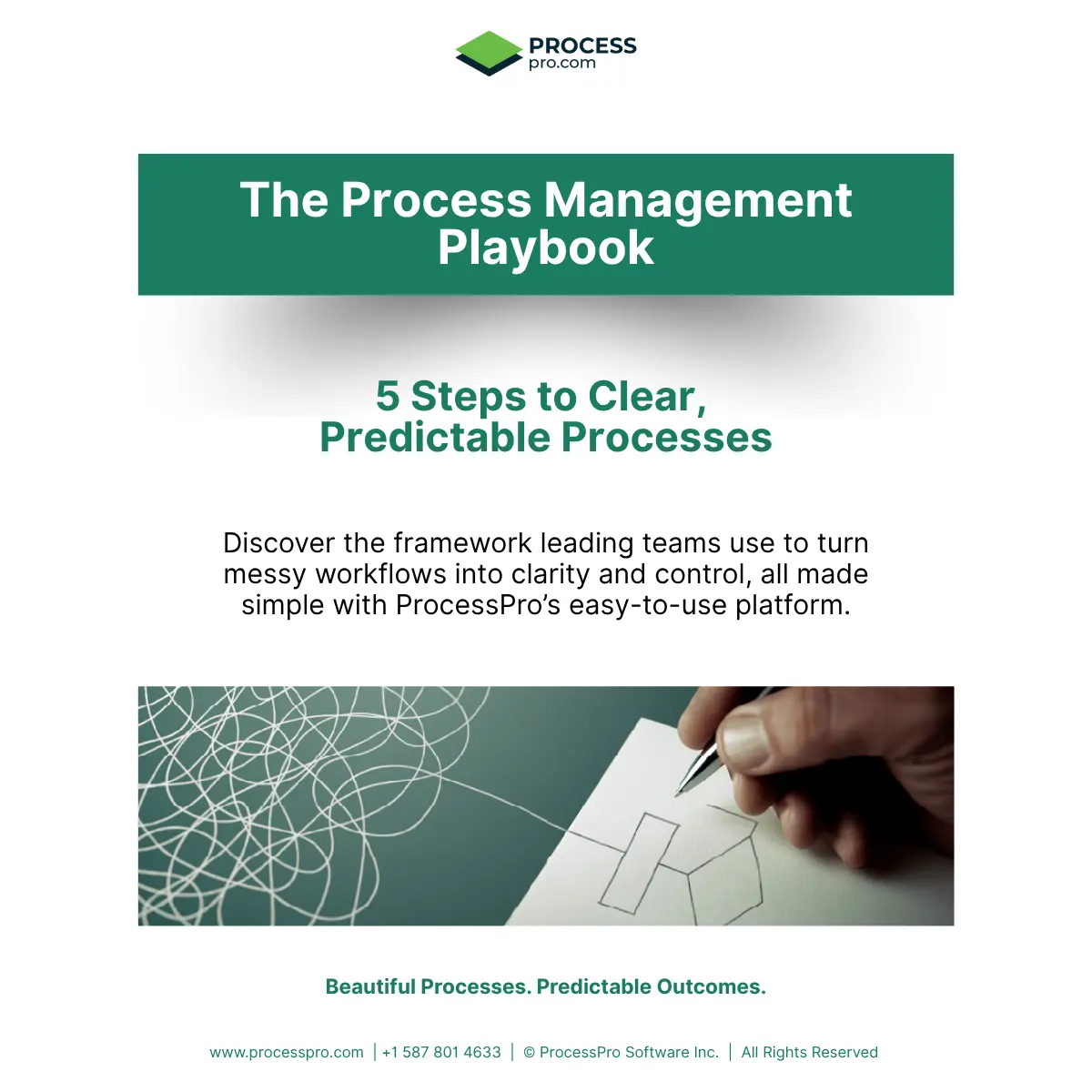
Want to start identifying where your biggest hidden costs are?
The Process Management Playbook gives you the 5-step framework for mapping, owning, and improving the processes that are most likely costing you time, rework, and risk right now.
Where Process Management ROI Shows Up First
The financial value of ProcessPro usually comes from five areas.
How Can Process Management Reduce Rework?
Less Rework
When teams work from different versions of the same process, they make mistakes, redo tasks, and waste time.
ProcessPro gives teams one clear, current version of how work gets done. That reduces variation, rework, and back-and-forth.
Many organisations waste 20 to 30 percent of operating time because workflows are unclear. Even a modest reduction in rework can save hundreds or thousands of hours a year.
One customer eliminated more than 1,000 hours of wasted effort each year by clarifying and standardising a process. That was close to a full FTE in recovered capacity.
How Do You Reduce Dependency on Key Employees?
Faster Onboarding and Less Dependency on Key People
Without clear processes, organisations depend too heavily on a few experienced staff members.
When those people leave, retire, or go on leave, performance drops.
ProcessPro captures how work is actually done and makes it accessible to everyone. New staff can follow clear processes instead of relying on memory, shadowing, or asking around.
One manufacturing customer reduced onboarding time from eight weeks to five after standardising work and making processes easier to access.
For operations leaders, that means less dependency risk and faster scale. For governance teams, it means knowledge stays in the business even when people leave.
How Can Better Process Documentation Reduce Audit Costs?
Process documentation software ROI often comes from reducing the time spent preparing for audits, finding the latest version of a process, or proving who approved what.
Good process documentation software reduces that effort by keeping approvals, versions, ownership, and evidence in one place.
Faster Audits and Lower Compliance Cost
Audit preparation is expensive because most organisations scramble to prove who approved what, which version was current, and whether people followed the right process.
ProcessPro keeps every change, review, approval, and version history in one place. That means evidence is ready when you need it.
One council reduced ISO audit preparation from a month to a single export. Valley Bank reduced audit preparation time by 40 percent and cut process risk incidents in half.
For risk and compliance leaders, the value is not just fewer findings. It is less time wasted gathering evidence and more confidence that controls are working.
How Does Process Management Software Save Money?
Process automation ROI and ROI of process mapping usually come from reducing delays, rework, duplicated effort, and manual admin.
Process mapping reduces delays, rework, duplicated effort, and dependency on key people. Process automation reduces manual admin, speeds up approvals, and keeps work moving.
Together, that creates a measurable return through faster work, lower risk, and fewer operational failures.
Process management software saves money by reducing wasted time, improving consistency, shortening approval cycles, and helping teams avoid errors and rework.
What Is Process Improvement ROI?
Process improvement ROI comes from making sure improvements actually stick.
Most organisations make changes during workshops or projects, but teams often drift back to old habits.
ProcessPro turns process improvements into standard work by giving teams one current version, clear ownership, review cycles, and visibility.
Most of the value comes from reducing process drift and making sure teams keep following the better way of working.
One government department simplified a five-step approval loop and saved 12 hours per request. A healthcare provider reduced its policy update cycle from six weeks to two. A university cut approval turnaround time by 28 percent after identifying delays through dashboards and feedback tools.
How Can Process Management Improve Compliance and Reduce Risk?
Lower Operational Risk
When work varies by person, location, or team, organisations see more incidents, missed deadlines, customer complaints, and quality issues.
ProcessPro reduces that risk by creating one agreed way of working, with clear ownership, approvals, review cycles, and notifications when something changes.
For quality and safety teams, standard work reduces the chance of incidents. For operations leaders, it creates consistency at scale. For governance teams, it creates confidence that processes are current and controlled.
What Is the ROI of Process Management Software?
Process management ROI shows up in the areas most organisations struggle with.
The ROI of process management software shows up in less rework, faster onboarding, shorter audits, better compliance, and fewer operational mistakes.
Less rework. Faster onboarding. Shorter audits. Better compliance. Fewer operational mistakes.
For some organisations, the value comes from process mapping because teams can finally see where work gets stuck.
For others, it comes from process automation because approvals, reminders, and routine tasks no longer rely on manual follow-up.
And for organisations focused on process improvement, the return comes from making sure better ways of working actually stick.
The common thread is simple. Better process management reduces waste, lowers risk, and helps teams work faster and more consistently.
Where Process Management ROI Shows Up in Daily Operations
Process management ROI is not usually about reducing headcount.
It is about reducing wasted time, removing rework, improving compliance, and helping teams work in a more consistent way.
Examples of Process Management ROI
Different organisations see value in different places.
A manufacturing business might reduce onboarding time from eight weeks to five.
A council might reduce ISO audit preparation from one month to a single export.
A financial services business might reduce process risk incidents by half.
A government department might save 12 hours every time a common approval process runs.
The return depends on where your biggest source of waste or risk sits today.
The Real ROI of ProcessPro
The real ROI of ProcessPro is usually not headcount reduction.
It is fewer mistakes. Faster onboarding. Less rework. Shorter audits. Less dependency on key people. Faster approvals. Better compliance. More consistent customer outcomes.
That is why buyers stop focusing only on software price once they see the cost of doing nothing.
A cheaper system still costs more if it leaves you with delays, inconsistency, audit risk, and wasted effort.
ProcessPro gives you one source of truth for how work gets done, who owns it, and how it stays current. That is what creates economic value.
Why Do Businesses Need Process Management Software?
Businesses need process management software because growth creates complexity.
As teams expand, work becomes harder to standardise, knowledge becomes harder to retain, and risk becomes harder to control.
Process management software creates one agreed way of working so teams can stay consistent, compliant, and productive.
If you are evaluating your options, compare the leading process management tools by use case, strengths and limitations.
How Can Process Management Help Teams Scale?
Scaling is not just about hiring more people. It is about making sure work is done the same way across teams, sites, and departments.
ProcessPro helps organisations scale without losing control by making ownership, accountability, and standard work visible across the business.
Frequently Asked Questions
What is the ROI of process management software?
Process management ROI comes from reducing rework, improving process consistency, shortening audits, and helping teams spend less time fixing mistakes.
The ROI usually comes from less rework, faster onboarding, reduced audit effort, lower operational risk, and more consistent outcomes.
How does process management software save money?
It saves money by reducing wasted time, improving process consistency, shortening approval cycles, and making compliance easier to manage.
What are the hidden costs of poor process management?
Poor process management often leads to duplicated work, slower onboarding, inconsistent customer experiences, audit failures, and higher dependency on key people.
Final Thoughts
Process management ROI is not about buying software for the sake of it.
It is about reducing waste, improving consistency, lowering risk, and helping teams spend less time fixing problems.
Most organisations already know they have process issues. The challenge is that they often underestimate how much those issues are costing them.
ProcessPro helps turn process management into something measurable.
Instead of relying on assumptions, teams can see where time is being lost, where work gets stuck, and where better processes create a real return.
Ready to see your process management ROI in action?
See where your processes are slowing you down, increasing audit time, and creating unnecessary risk.
In this session, we’ll show you:
- where rework is happening
- where approvals and audits slow you down
- how to reduce operational risk
- how to improve onboarding and consistency
Book your ProcessPro demo and see how to reduce cost, improve control, and scale your operations with confidence.
Not ready for a trial or demo yet?
The Process Management Playbook is a free guide to building the process foundation that makes ROI measurable — a good place to start before any platform decision.

James Ross
Founder & CEO. James is passionate about all thing Process Mapping and sharing his wealth of experience with his valued clients. He works closely with his teams to ensure that ProcessPro solves real everyday process mapping problems.
Share this article