
You ran the workshop. The team was energised.Six months later, nothing’s changed.
Improvement projects create momentum. Teams leave feeling optimistic. New ways of working are agreed on. But then the real world kicks in – busy periods, staff changes, competing priorities – and the improvements quietly erode back to how things were before.
ProcessPro gives CI managers the system to lock improvement into business-as-usual – so changes survive long after the project ends.
- For Continuous Improvement Managers
We’ll show you how to keep improvement alive.
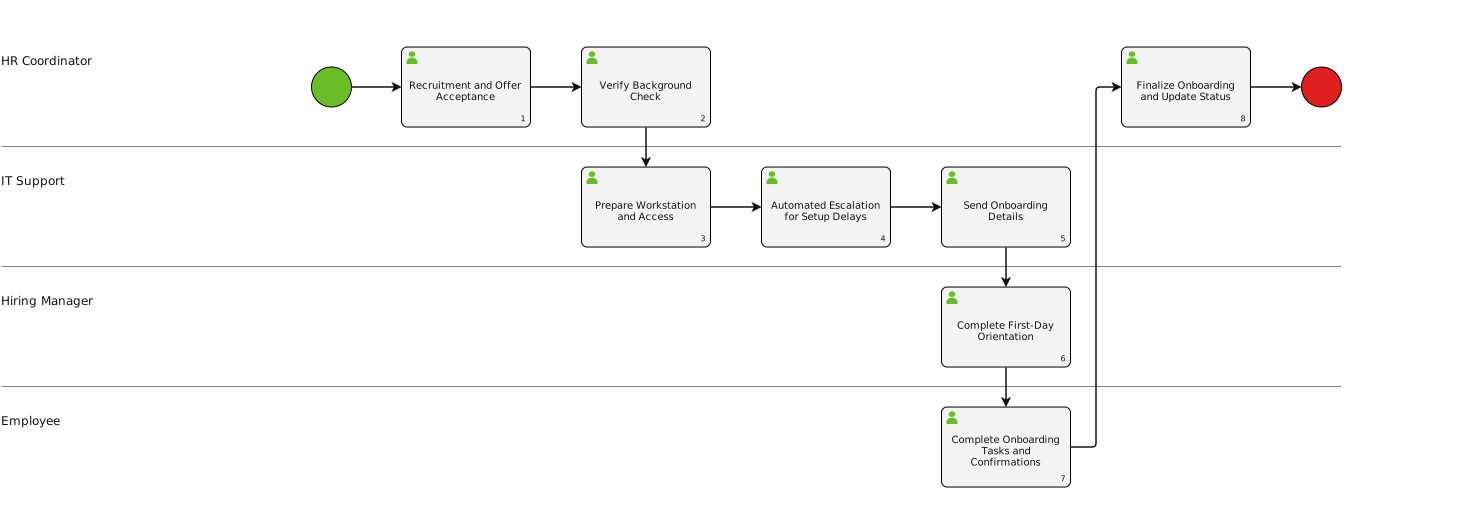
The improvement lifecycle, governed
- Improvement updates the live process, not a slide deck
- Ownership transfers to a named process owner
- Version control tracks what changed, when, and why
- Review cycles catch drift before reversion becomes normal
- TRUSTED BY OPERATIONS TEAMS AT









Improvements don't fail because of bad ideas. They fail because there's no system to sustain them.
Every CI manager knows the cycle:
Day one
The workshop went well
The team mapped the future state, agreed on changes, and left with clear action items.
Week six
Implementation happened… mostly
The quick wins landed, but the deeper process changes got patchy adoption.
Three months
You check in
Half the team’s following the new process, half reverted to the old way, and nobody’s sure which version is correct.
Six months
It’s over
The improvement has faded into background noise and the original problem is creeping back.
The root cause isn’t resistance or lack of effort. It’s that improvements were designed as projects, not embedded as standard work. There’s no system to update the documented process, assign ownership for the new way of working, or enforce the change beyond the project lifecycle.
And so the improvement treadmill continues – workshops generate momentum, but nothing actually sticks.
From improvement projects to sustained operational change.
ProcessPro gives CI managers a system where process improvements aren’t just implemented – they’re owned, documented, and locked into how the organisation works permanently.
No more improvements that live only in workshop outputs and slide decks. No more ambiguity about which version of a process is current. No more relying on individual champions to keep things alive after the project team disbands.
The result: every improvement you deliver actually compounds, because the foundation holds.
- With ProcessPro:
- Every process has a clear owner - the improvement doesn’t depend on the CI team to sustain it
- Changes are version-controlled and reviewable - you can track exactly what changed, when, and why
- Standard work is visible and accessible - teams follow the updated process because it’s the process
- Review cycles prevent erosion - scheduled checks catch reversion before it becomes the new normal
- The CI team can move on to the next improvement - because the last one is embedded in the system
What changes when improvement lives in the system, not in the project.
- Before ProcessPro
- Improvements documented in workshop outputs, PowerPoint decks, and email threads
- No clear ownership after the project ends - sustainability depends on whoever cared most
- Teams follow the new process for a while, then quietly revert
- No way to track whether improvements are still being followed six months later
- The CI team becomes a permanent support function - constantly re-implementing old changes
- Each new project starts without knowing whether previous improvements survived
- Process maps are created for the project, then filed and forgotten
- After ProcessPro
- Improvements update the actual process - the system of record reflects the new way of working
- Ownership transfers to the process owner - the CI team can move on with confidence
- Teams follow the updated process because it's visible, accessible, and authoritative
- Review cycles flag when processes drift - reversion is caught early, not at the next audit
- The CI team focuses on driving new improvements - not re-litigating old ones
- Every project builds on a foundation of sustained, documented change
- Process maps are living documents that evolve with the organisation
Built for organisations where continuous improvement is more than a buzzword.
ProcessPro is trusted by CI managers in:
Manufacturing
Embedding lean, Six Sigma, and kaizen improvements as standard work across production, quality, and engineering.
Healthcare
Sustaining clinical and administrative improvements across facilities and departments.
Government
Locking service delivery improvements into ongoing operations.
Utilities
Maintaining process improvements across infrastructure, field operations, and compliance.
Financial services
Standardising procedural changes across branches and back-office functions.
How CI managers make improvement stick with ProcessPro
Power Equipment
(NZ & Australia)
- Replaced fragmented, person-dependent workflows with governed standard work across multiple offices
- Improvement changes now update the live process - not a separate project document
- Clear ownership and review cycles prevent process drift across brands and locations
Valley Bank
($62B+ assets, multi-state US)
- Standardised how procedures are documented and maintained after years of ad hoc improvements
- CI teams can implement changes knowing they’ll persist beyond the project lifecycle
- Reduced the gap between “what was agreed” and “what’s actually followed” across departments
Brookville Equipment
(Manufacturing)
- Embedded process improvements into standard work instead of leaving them in workshop outputs
- Created ownership and accountability structures that sustain change without ongoing CI team involvement
- Improved cross-functional consistency - engineering, procurement, and operations follow the same documented standard
Stop running the same improvement twice.
We’ll show you how ProcessPro turns your improvement projects into permanent operational change – using a real process from your organisation. You’ll see exactly how your team would document, own, and sustain the improvements you’ve already delivered.